Showing posts with label Auguste Toulmouche. Show all posts

Friday, April 14, 2017

The Kiss (1886)

Auguste Toulmouche: The Kiss

Twenty years after The Reluctant Bride and only 4 years before his death Toulmouche painted The Kiss, another work which for me shows some “grit” in the ideology of the licked surface of French academic painting. Once again the painter creates his trademark- an elaborate and opulent interior in which to enact the work’s narrative.

The scene occurs in a private dining salon... In the center of the room is a small square dining table covered with a creamy white tablecloth with long fringe and a cutwork inset. The table is laden with a gorgeous still-life of fruit in a china compote. There are crystal glasses, other china dishes and a large bottle of champagne. A second bottle in a silver ice bucket sits on the rug next to the table leg. Two typically French upholstered gilt wood chairs are also partially visible.

And who are the players on this beautiful stage? They both wear costumes rather than the everyday clothes of the 1880’s. Perhaps they have attended a costume ball and have now slipped away from the crowd for a private dessert tête-à-tête. The man on the left wears the white satin outfit of a French Pierrot, a character from the French Commedia dell’ Arte. But this is no sad clown pining for love. This clown is kissing the object of his desire. He wins his Columbine.

She is a beautiful object with dark hair and porcelain skin. She wears a pale pink silk dress with a fitted bodice and a tiered ruffled skirt in a slightly deeper pink. The skirt has an overlay of tulle-like fabric embroidered with shiny silver flowers. A bouquet of pink roses appears to fasten and gather the tulle creating a sort of bustle. She completes her coquettish look with delicate pink shoes and a jaunty white hat with a white feather.

I do not recognize her costume. Is she a courtesan, a prostitute, a mistress? A courtesan like Zola’s Nana? But, this painting is many years after Napoleon III though Nana set in the Second Empire was written in 1880, so perhaps there is a connection. Otherwise, it is unclear.

What is evident is the passion of their kiss. The painting captures a fevered moment. It is as if suddenly seized by desire in this private space, the man and woman push back their chairs and take the shortest route to each others' lips - across the table, leaning forward on their palms. They kiss above the compote overflowing with colorful fruit. There is a visual (oral) slippage between the fruit - ripe, juicy, ready to be eaten, ready to satiate the eater and give him/her pleasure and the kiss - the touching of moist lips, mouths wet with saliva, mouths and tongues ready to enjoy and be enjoyed, the pleasure of a physical connection with a desired individual in a darkened, intimate and private room.

The Kiss is a passionate painting devoid of sentimentality but brimming with the desire that all of us experience and have experienced being in a room alone with someone we fancy, sharing a glass of champagne with him and some good food and delighting in that first kiss, that first touch. This painting is unlike the sappiness of other Toulmouche works like The Love Letter or the type of academic painting that verged on soft core pornography such as Love on the Lookout by William-Adolphe Bouguereau from 1890. (In the Bouguereau, idealization ends and creepiness begins.) In this way, therefore, The Kiss disrupts the ideology of the licked surface and its notion of the ideal and the thought- represent LOVE not love. Though the figures in the Toulmouche are costumed, they are grounded in a reality of passion and desire and not an evocation of an abstract idea through a mythical or historical subject. [The Great Within]

Sunday, August 7, 2016

Auguste Toulmouche (1878)

 Auguste Toulmouche: At the Corner of the Fire
  
Auguste Toulmouche: Reflection of Beauty

Friday, July 15, 2016

Auguste Toulmouche (1877)

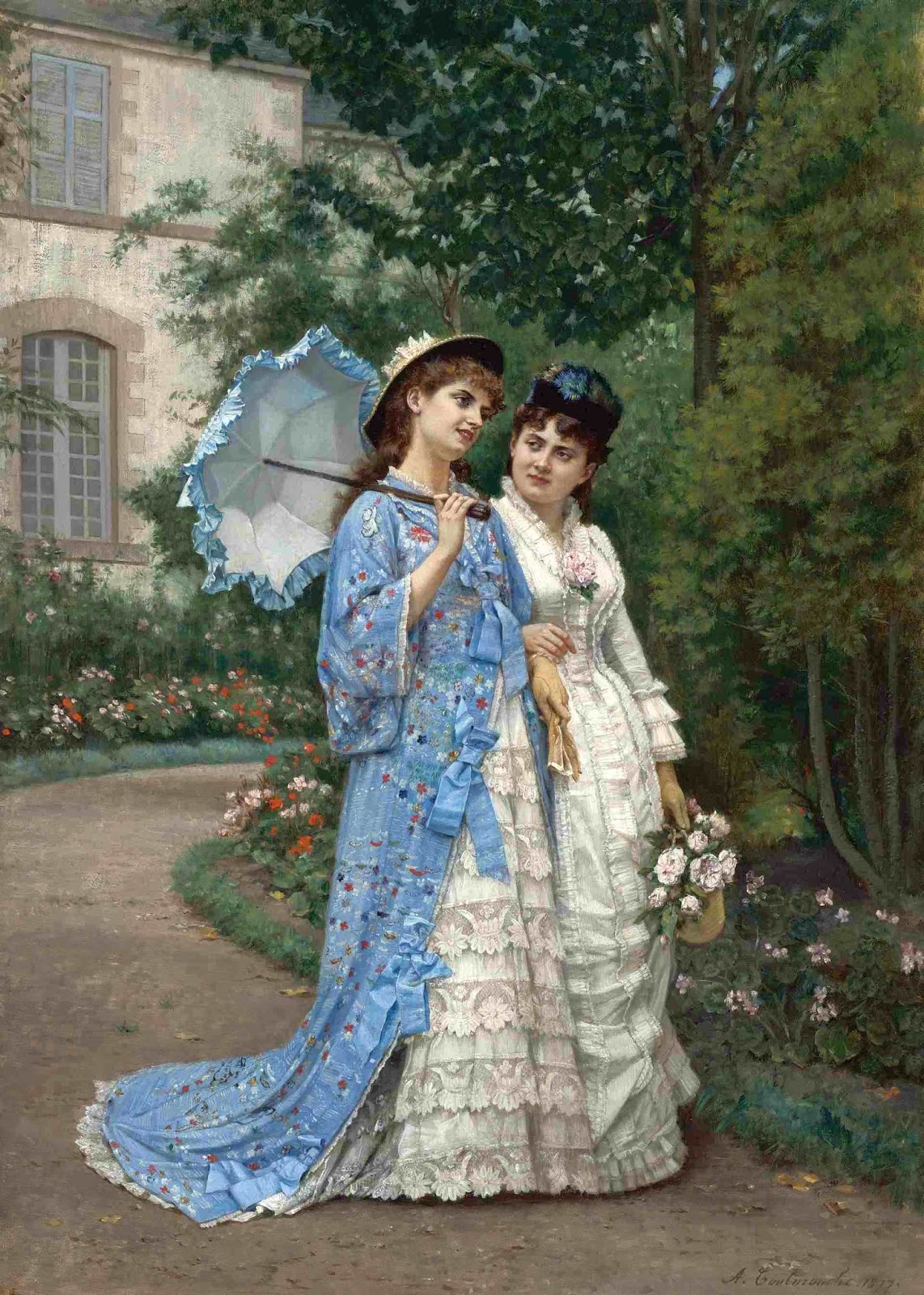
 Auguste Toulmouche: A Garden Stroll
  
Auguste Toulmouche: Dolce far niente

Tuesday, April 26, 2016

An Afternoon Idyll (1874)

Auguste Toulmouche: An Afternoon Idyll

Auguste Toulmouche enjoyed notable success during the Second Empire with his paintings of attractive and lusciously decorated bourgeois interiors and elegantly dressed ladies. He was a student of Marc Gabriel Charles Gleyre and debuted at the Salon in 1848. His entry into the Salon of 1852 won him a third class medal, followed by a second class medal in 1861 and another third class medal for his entry into the 1878 Exposition Universelle (the first class medal at this event was awarded to William Bouguereau's La Charité). Toulmouche was appointed Chavalier de la Lègion d'honneur in 1870.

The fashionable gowns decorated with large satin ribbons, ruffled lace sleeves and multiple petticoats demonstrate the absolute height of fashion in France during the mid 1870s. … Painstaking detail has been put into the modeling of these fantastic gowns as well as their luscious fabrics and bright colors. In fact the color pink was a rather recently developed artificial dye at the time, and along with other newly invented luxuries of this period it suggests opulent consumption, an emblem of an era which is popularly called La Belle Epoque.

During a time of such riches, luscious consumption was not only satisfied through fashionable gowns and exquisite lace but also through the acquisition of antiques and rare objects imported from foreign lands. The vogue for japonisme peaked during the Second Empire and Oriental screens, blue and white porcelain, and even kimonos were being assimilated by artists across Europe, from James McNeil Whistler to Jean-Jacques Tissot and Edouard Vuillard. The use of a Japanese screen in Tissot's 1869 Salon entry titled Young Ladies admiring Japanese Objects would have been viewed as both exotic as well as sumptuous. In An Afternoon Idyll, Toulmouche introduces a similar element with the use of the screen, in order to complete and compliment this very extravagant composition. [Christie’s]

Saturday, February 6, 2016

Auguste Toulmouche (1872)

 Auguste Toulmouche: In the Library
  
Auguste Toulmouche: The Blue Dress

Friday, September 4, 2015

The Reluctant Bride (1866)

Auguste Toulmouche: The Reluctant Bride

A favorite painting of mine for the human drama depicted. I find most of Toulmouche's works to be on the vapid side - mostly showing elegantly ladies at leisure. This one, however, tells a story - an old story, to be sure, and one told by many artists in many lands. To me, this bride doesn't just look reluctant - she looks downright angry about her situation and the inescapability of it.

Thursday, February 5, 2015

A Classical Courtship (1853)

Auguste Toulmouche: A Classical Courtship

Auguste Toulmouche (1829-1890) was a French painter who painted in the academic realism style. This trend in art was towards realism but also towards greater idealism, which is contrary to realism. The figures depicted were made more abstract and idealized. His themes were in the Regency revival style of genre painting. This would involve both generalizing the forms seen in nature, and subordinating them to the unity and theme of the artwork.

He studied with Charles Gleyre and is known mainly for his portraits of Parisian women; Émile Zola spoke of "Toulmouche's delicious dolls." He was made a Chevalier of the Legion of Honour. [Wikipedia]

A more extensive bio of Toulmouche is at Rehs Galleries.